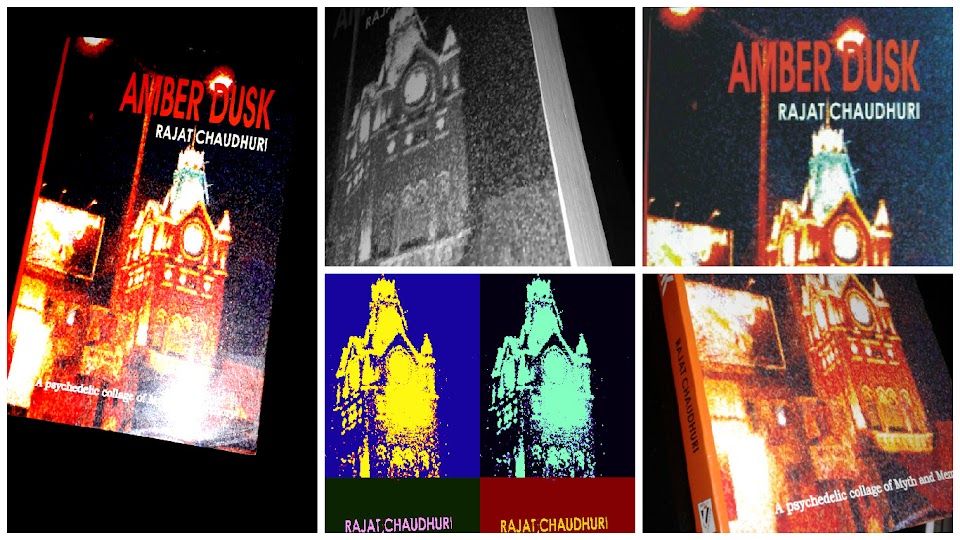
Reviews, notices, citations, honours for the novel Amber Dusk:
The Telegraph
Indian Literature (Sahitya Akademi journal, May-June 2008) (Review)
NDTV
The Statesman
The Hindu
Deccan Herald (review)
Deccan Herald (notice)
Canon and Identity in IWE (Citation)
Journal of Commonwealth Literature, Dec 2008 (Citation)
The Asian Age
The Echo of India
Pre-release reviews
Vodafone Crossword Book Awards Longlist
(Click on the above links to read the reviews. More reviews will be added as they appear)
Saturday, May 17, 2008
Amber Dusk-Some Reviews
Posted by
Rajat Chaudhuri
at
1:40 AM
1 comments
Links to this post
Labels: amber dusk, asian age, book, critical review, deccan herald, echo of india, France, India-France, novel, review, The Telegraph
Friday, May 16, 2008
Amber Dusk - A citation in a paper on `canon' and `identity' in IWE
Excerpt from the paper `Contextualizing the questions on “canon” and “identity” in Indian Writing in English' by Prof Niranjan Mohanty:
I would like to conclude this paper by citing from a young fiction writer of Kolkata, Rajat Chaudhuri. His debut novel Amber Dusk (Delhi: Indialog Publication Pvt. Ltd, 2007) represents a psychedelic collage of myth and memory. It is a novel in which Kolkata and Paris figure luxuriatingly, creating a different verve, a striking sense of pulsation, bedecked by intricate moon-moments of love and intimacy. I shall cite here only those lines out of the many, in which Chaudhuri captures the rhythmic beauty of Kolkata life ridden with politics:
That night the government of the State of West Bengal was also working overtime. At the solid looking red –brick Writers Building from where the state is governed there was an urgent meeting of powerful ministers. The sweet makers were going on a day’s token strike. All sweet shops in Calcutta and all over the state would remain closed on Sunday. If the government did not budge, and went ahead with the new law, then this would be followed by continuous strikes. The Ruling Reds were jittery at the news. They knew that if the Bengalis were parted from their mistis, sweet, anything in the world –even the most absurd and unimaginable –would happen. (25-26).
I believe, even if young, Chaudhuri has successfully represented the state politics in West Bengal and the sweet-loving attitude of the Bengalis. There are certain things in life which do not go away and these certain things contain and constitute one’s identity, the substance or essences of one’s identity, whether these belong to what Ramanujan calls “outer” or “inner” forms and what I call ‘circles’ the ‘concentric circles’ that define, project and represent one’s identity.
The full text of the above paper is available here.
Copyright notice: The copyright for the paper `Contextualizing the questions on “canon” and “identity” in Indian Writing in English' belongs to Prof Niranjan Mohanty and any organisation to which he may have temporarily vested this right. All rights reserved.
Posted by
Rajat Chaudhuri
at
12:47 PM
0
comments
Links to this post
Labels: Reference Amber Dusk Canon Identity IWE Indian Writing in English
Thursday, March 6, 2008
A New Extract
Some more days. He would take his time. Let the rain beat down on him and the sun cauterize his wounds. Let the animals circle round him and dance their strange tarantella. The weariness would leave him and he would wake up to a new freshness, new and soaped clean without Shang dragons haunting him or Lopamudras titillating him. He had had his flirtation with all that, a real heck of an affair - deep down and reality-rich and there were things he had learned. But it was a dangerous game, a thankless dice-game, like going deeper and deeper into the bowels of a darkness in search of more of the artificial light that illuminates hidden corners of it, deeper and more of those flashing neons, the burning strobes and pink incandescence, but deeper too and deeper still.
The little river sniggered as it went by. Pedro stared at the clear water and the white and black stones on its bed. Why do you bring hard days to these people, he asked the river. Are you the river of bad news and ill omens? But the river did not answer. It sniggered and flowed by. Like an insult it went on going. And in the starlight he saw it winding away far away into the hills and through the forests and in a flash he saw it like an enormous serpent twisting and coiling over the red earth, hissing menacingly. His hair stood on end as in the dark night he saw the stream transformed into a poisonous ominous reptile of death. A blue slithering demon.
He moved away from the bank of the river, blue in the starlight and looked the other way. Should he tell what he had just seen to Suhuria? No, they are superstitious people and they will be scared. No use scaring them. If he does some good turn in life now was his chance to do it. He would help these people. He would teach them how to tame this serpent that was sneaking into their lives. Teach them some lessons in living. Living like head-high men, men of glory, of the present. The hills were laughing as he walked back to his hut.
He did not get much time though. A week and half later on a lovely clear night he heard the sound of gunfire from the village. And shouting of men and women blew in with the wind. Cries of pain. He was not sure what he should do. He waited. Could be dacoits attacking the villagers, so he should be careful. A few moments later he stepped out and walked cautiously to the village. Carefully through the darkness, stopping every time a shadow came to life. Or the trees whistled. Then when he was almost there he saw the darkness pierced by the powerful headlamps of a jeep. There were no proper roads leading to this village so only jeeps could travel but this was being driven like crazy. And the screech of the brakes as it backed out, like a thoughtless machine gone insane, wheels whining in protest. Ruthless; the lights changed direction as the vehicle climbed onto the laterite road and the engine roared with power. He stepped off the footway and planted himself carefully behind a big tree and watched the impudent driver scream the vehicle and madly disappear between the rows of trees. The jeep was packed with policemen.
At the village he was greeted by a terrible silence. Terrified villagers were slowly coming out of their huts and standing silently at their doors but no one said anything. Alarmed men and women choked into speechlessness. He went up to the village headman and asked him what exactly had happened. `Police came and fired on us,’ he said sulking away to where a group was beginning to assemble. Then he saw Suhuria among them. They were attending to two men with wounds on their legs, waist and body. Blood was flowing freely from the wounds and someone was washing these with water. One of the two was gasping as if life was jostling at the door to escape from the injured body while the other moaned and shrieked, tossing from side to side. His face had a mad wild look, setting into a queer mask of agony. The bullets had shattered his kneecap and damaged his ilium. The gasping man had a punctured lung. Luckily, there was a doctor among the group of tourists staying at the village and he took charge of it. A tall villager held the lantern up higher for light but still it would be mostly luck, and in ample proportions, that could save the life of these poor villagers, far as they were from proper medical aid and other guarantees of civilisation. Villagers carried the men away, one still screaming and twisting in pain contorting his face the other falling gradually silent.
The police came, Suhuria told him, looking for the bhattis and they protested. `They would have broken and destroyed everything and so we didn’t allow them. They tried to enter our houses and one of them misbehaved with our women! That mongrel Sukumar! We all came out and threw bricks and stones at them and that was when they fired on Marang and Shukrua.’ He was panting heavily.
Pedro tried to calm him but it was not easy. He took him to his hut and tried to talk about other things. `The doctor will take care of Shukrua and Marang,’ he tried to assure him falsely. But it did not work. Suhuria’s eyes were fired with hate.
`I will skin that devil Sukumar alive!’ he growled thumping with his fist. Pedro poured him some mahua and helped him drink it.
`You have to control yourself, I know this is intolerable but…’ Pedro tried to reason.
`How can I sit here without doing anything while they come and kill my people and destroy our living. We have to sell the drink to live! We have to; the mustard and paddy are so undependable,’ Suhuria was emphatic as his heavy words brutally bludgeoned the diffident silence of the night.
Pedro imagined Suhuria would make a good leader for his people and perhaps lead them on to a kingdom without cares, a kingdom free of all dependence, self-sustaining and happy. A land where power walks with head-hung in shame; where the will to power is cloaked in ignominy. Where men are free. Here in the village where he was big, Pedro believed freedom for all to be a desirable commodity. But somewhere deep within Pedro did not trust leaders. The glorious trait of leadership failed to impress him at all.
What a peaceful place the world would have been if men and women did not have leaders, he thought. Because it is leaders around which power builds its home. It is the stout shoulder from which force hangs its black bow, it is the brazen chamber where coercion bursts forth from its egg.
If there were no leaders - political, religious, business, tribal and more - individual conflicts, individual avarice, individual lust, individual cupidity would never become matters of collective emotion and there would be no manipulation, no driving of opinion. I would be blessed to be born in such a world, Pedro dreamt and wondered. Leaders and leadership, he believed it now, are behind a lot of collective unhappiness and violence that the world sees today. As if within the heart of the leader, are nurtured all the sorrow, all the woes of our lives.
Could he do anything? Was it necessary for him to worry? Perhaps if Rishi was here he would have discussed his thoughts with him and plan a glorious utopia and if, like Count St Germain, he could live hundreds of years he would experiment with one of these desirable solutions. An experiment of utopia within a small group of people just for starters, a model for emulation on grander scales later, perhaps. This little hamlet would be an ideal place to start experimenting. But would it be worthwhile, everything was so obvious, how easy it was to see within the hearts of men. Of course Rishi would talk of eugenics if he agreed with his thoughts about leadership. Leaders, their offspring, and those with inborn leadership qualities should not be allowed to breed, that is what Rishi would say. Castrate leaders! Sew the labia majora of empresses! Vasectomise some VIPs. Or, if it is possible, perhaps their leadership gene should be plucked out or neutralised. But who will do it? Won’t we need another leader to do that and coercion to make the poor leaders agree to this eugenic planning exercise? It all boiled down to hopelessness and, unlike Rishi, he did not put much faith by eugenics. Very easily, Pedro believed, eugenics becomes a dirty tool of power.
If you, oh weary friend!
Stand by this lonesome hill,
Mourn me not but do me lend,
Your stick to tame the will
RIP
Endless Equality Endeavour
(A horn of The Human Followership Development Project)
(1871- Present)
His thoughts calmed as he visualised this gravestone in his mind. But he would give Suhuria a few ideas. Of course, he would not ask him to lead a self-defeating revolution. There were smarter things on his mind.
Copyright 2007, Rajat Chaudhuri, All rights reserved.
Posted by
Rajat Chaudhuri
at
9:42 PM
0
comments
Links to this post
Labels: Amber Dusk Extract
Another Extract
Rishi dived low, catching Fenella’s fleshy waist, almost using her like a shield, as a roasted duck flapped dangerously close overhead, going in the direction of Loos. All the projectiles were being hurled at that target behind the sofa but because it was hidden it was impossible to assess the effects of this fusillade. Rishi noticed that the `FAD’ had disappeared. But his red carnations were all over the room. A small man with a crutch were tearing these gleefully and throwing the petals all around while the art school students had stuck the flowers in their hair. Someone was loudly counting out the number of glasses being broken …cinq…six…sept…Lamb chop!…huit…neuf…Carafe!…dix. ..onze…douze…
At one point Rishi thought he saw a man trying to set fire to the curtains.
While the missiles flew over them the pony-tailed man and two others, on all fours, carefully closed in on the sofa. One was Pierot, now violent with frustration, and the other was Gascoigne. They crawled close to where Loos was hiding but he was quick on his feet, and, throwing his other boot at some china on the mantelpiece, he dashed for the door and out onto the stairs. The group of three followed, one arming himself on the way with someone’s silk umbrella with Tintin prints, and another wrenching out the telephone shower from the bathroom. Water began to gush out from the damaged pipe. Gascoigne’s hall would soon be flooded.
The deep thundering voice of Loos could be heard shouting followed by cries of pain and mad footsteps. ‘Oh Mon Dieu!’ cried a shrill feminine voice from the floor below followed by the heavy sound of something rolling down the stairs. Then there were more shouts and cursing. It seemed at one point that the whole building had come out on the stairs.
Gascoigne’s ship was rocked to the core. This old house on rue Cafarelli had been called The Ship for long and Gascoigne’s ship - navire de Gascoigne - a place expansive as a ship’s deck and with a pleasant breeze of poets chatter and photographers clicking talk about cameras and reciprocity failure, about depth of fields and the hum of writer’s discussing women with musicians was all so pleasant, like gentle breeze.
But what hard wind had Loos raised today, Rishi thought; that so rolled and pitched this vessel of merry hashish-smoking voyagers? Working for art. Working for food and shelter, and this pleasure of quite civilly - apparently like law-abiding citizens - doing something that was always a protest, a shout in a library, a secret extravagant living that was tax-free, a balloon on the skies above Paris, a cocooned caprice that seldom attracted chastisement.
A young black man was trying to restore the failing confidence of the sailors by playing on his harmonica. But no, it would not work. Tonight was too much for them and people began to leave.
Fenella asked Rishi and Daniel if they would like to join her for a drink, `to forget the bad part of the evening.’ Daniel said he would like to but he had to feed his cats and it would be too late.
'I am sorry but maybe tomorrow we could meet in the evening,' he added apologetically. 'But if Rishi is going with you, you have to put him in a good taxi or drop him home. He is still new to Paris and wouldn't like to get lost. Would you my friend?' He smiled delicately his hands in his pockets, slightly bending his head forward. Then he vanished before them in the darkness.
`He is a marvellous person,’ Fenella said and Rishi could not disagree. Yet just now and, once in a while, he would remember that deadly weapon he had accidentally discovered in Daniel’s apartment. Today, perchance, he had found out that Daniel was carrying the blowpipe under his jacket. The weapon was hanging from a shoulder strap and Rishi had seen it when Daniel helped him with the snail-grippers at the bistro. That’s why, today, he never took his jacket off, Rishi pondered. Nodding his head to Fenella’s comment he tried to think of a simple explanation, but none appeared.
They were out on the street. The ship was again slipping back to fair wind as they walked out. Most lights in the flats had gone out and the angry noises, clapping and music of the second floor flat had dissolved into the quiet humming of life behind closed windows. From a ground level flat, a faint music could be heard. Someone was playing Debussy's La Mer and the sweet music rolled into the quiet street and spread slowly towards the islands of silence all around.
`I had borrowed a friend’s car. Parked it somewhere here,’ Fenella said in a slurry voice, walking drunkenly along the row of automobiles parked along the street. She stopped beside a small white Peugeot. They got in. Till now, when he was comfortably beside her inside the warm car, Rishi could not help thinking of Loos crouching in one of the clumps of dark shadows and ready to throw a dangerous projectile to hurt him and Fenella. But nothing of that sort happened.
Only as Fenella has pulled out into the wide road the sky broke into scary laughter flashing its white teeth on its dark face, like the face of Djibo at the party, the man who had made the last effort with the harmonica.
The roll of thunder echoed and strengthened itself all over the city and came back to them in waves - satisfying sounds, old like the old earth. The big RATP buses with the huge rear view mirrors - like fairytale characters with long ears - slid by smoothly on the soaked streets with swish sounds. Small rain had begun and through the rolled up windows, Paris suddenly presented a different and enchanting face.
Instinctively he looked at Fenella driving the old hatchback and she just then turned and looked at him. Their little car was a small safe submarine in the stormy seas of life happening outside - in the cafés, inside the air-conditioned hearts of the fairy-tale characters, beneath the transparent passenger sheds where the late-nighters waited. It was a cosy caravan, a small shellfish-pleasant retreat from the crashing skies, the maddening drops; they looked more anarchic from within their steel and glass retreat. Like fifty thongs they lashed above their heads and all around.
Strange pleasure to be thus protected, while the world outside soaked and changed before your eyes. Received its chastisement. The night rain fell across the car windows, clouding out the view, and the big lights and dancing lasers outside dissolved in slippery blobs of illumination, plum puddings restless to be eaten. Fenella’s sharp face and light eyes hung in the pondering warmth of the car as at the edge of a precipice, something should happen now, and the windshield wiper carelessly kept time. Rain drummed on the roof.
The plane trees on the Seine and the big statues in the parks and squares - Anne of Austria in the Luxembourg and Henri IV at the place des Vosges – quietly enjoyed the rain, getting drenched and secretly dancing with mirth. The city was one with the heavens, from the merry greens of the Bois de Boulogne in the east to the huge well laid out parc de la Villette in the west, from the old le Bourget airport and the workers colonies in the north down to the far reaches of the Montparnasse, there was a communion with the elements, a joyous stigmatisation. And in this ceremony the saint was Paris and the stigmata would be the fresh leaves of plane and ash, and the washed look of the streets the next morning, until the dust and rankle of industriousness would again transfer it to a place in the world.
He stole a look at her legs guiding the machine, pressing on the accelerator, as their silvery boat nipped through the scenes of chastisement and reward, agony and ecstasy. Aviation kerosene, sin the shade of a baby’s eyes. He remembered how he had held her waist at the Ship and wanted then, to hold her again. Sturdily, with the grip of a dead man. And he felt warm and excited. Secret formulas turned keys in his brains, pressed switches all over his body and he was shivering. He inhaled deeply the scent of her hair. In the unsure darkness, red sometimes looked orange.
As if hearing his thoughts she said, `I go dancing, such nights.’
Copyright 2007, Rajat Chaudhuri, All rights reserved.
Posted by
Rajat Chaudhuri
at
9:10 PM
0
comments
Links to this post
Sunday, November 25, 2007
Calcutta Streets
Posted by
Rajat Chaudhuri
at
12:23 AM
0
comments
Links to this post
Labels: amber dusk, bookshops, calcutta, calcutta book fair, city, Cross-culture, echo of india, France, India-France, Kolkata book fair, novel, protest march Kolkata
Saturday, November 24, 2007
Parc de la Villette
Someone took this snap
of mine at the Parc de la Villette in Paris. This park, a master design of Bernard Tschumi is a must visit for lovers of architecture and design and was built over a huge slaughterhouse in this area. Paris is an abiding theme and setting for Amber Dusk.
Posted by
Rajat Chaudhuri
at
10:29 PM
0
comments
Links to this post
Labels: amber dusk, architecture, bernard tschumi, Cross-culture, design, echo of india, France, India-France, novel, parc de la villette, paris amber dusk
Lake Malren
Lake Malar
en of Stockholm is at the heart of the novel. I had taken this photograph of the mystical Malaren one chilly evening sitting on the deck of the barge restaurant-The Ludwigschafen. Don't ask me what camera...
Posted by
Rajat Chaudhuri
at
10:25 PM
2
comments
Links to this post
Labels: amber dusk, Ludwigschafen, malaren, mysticism, stockholm, The Red Boat
Jacket Designs
This is an early jacket design for the book. At that point the novel seems to have a different title! Many different versions of this design were tried but finally the quality of the image was not good enough. I took this photograph of a whirling dervish (coloured red) at the École des Beaux-Arts in Paris. The woman in the foreground was in the audience.
Posted by
Rajat Chaudhuri
at
10:21 PM
1 comments
Links to this post
Labels: amber dusk, cover design, Cross-culture, dervish, echo of india, Ecole des Beaux-Arts, France, India-France, novel, paris, whirling dervish
Wednesday, October 10, 2007
Amber Dusk – About the book
AMBER DUSK smells of Calcutta streets and resonates with the seductive tunes of Parisian nights. Robot oracles, the enigmatic photographer Valence Jourdain, a shadowy Blue Princess, Indian tribesmen and the mystical Lake Malaren colour this fascinating narrative, creating an edgy reality. The novel presents a rich tapestry of ideas weaving together Calcutta and Paris and the lives and passions of the unforgettable individuals that walk their streets. Here is a delicately crafted story about love, loathing and beatitude and the quest for peace in a time of intolerance.
Posted by
Rajat Chaudhuri
at
8:05 PM
0
comments
Links to this post
Labels: amber dusk, calcutta, malaren, novel, paris, rajat chaudhuri, robot, stockholm
Gypsy Mug - The dedications page of Amber Dusk
Amber Dusk is dedicated to this coffee mug. The mug belongs to a Gypsy who is the best-fortune-teller known to me. This Don Williams song goes out to her, wherever she may be now. The Spanish Gypsy girl Carmen’s story, which inspired scores of films, hovered somewhere at the back of my mind while writing this book.
Posted by
Rajat Chaudhuri
at
8:00 AM
0
comments
Links to this post
Labels: amber dusk, carmen, coffee mug, dedications, don williams, fortune-teller, gypsy calcutta, novel, paris, rajat chaudhuri
